
Finance
The Hidden FX Fees That Eat Your Holiday Money – And the UK Cards That Help Avoid Them
Every time you swipe a card abroad or convert currency at the airport, banks take a quiet cut that never appears as a line item. Here’s what it costs, who charges least, and the cards worth having before you fly.
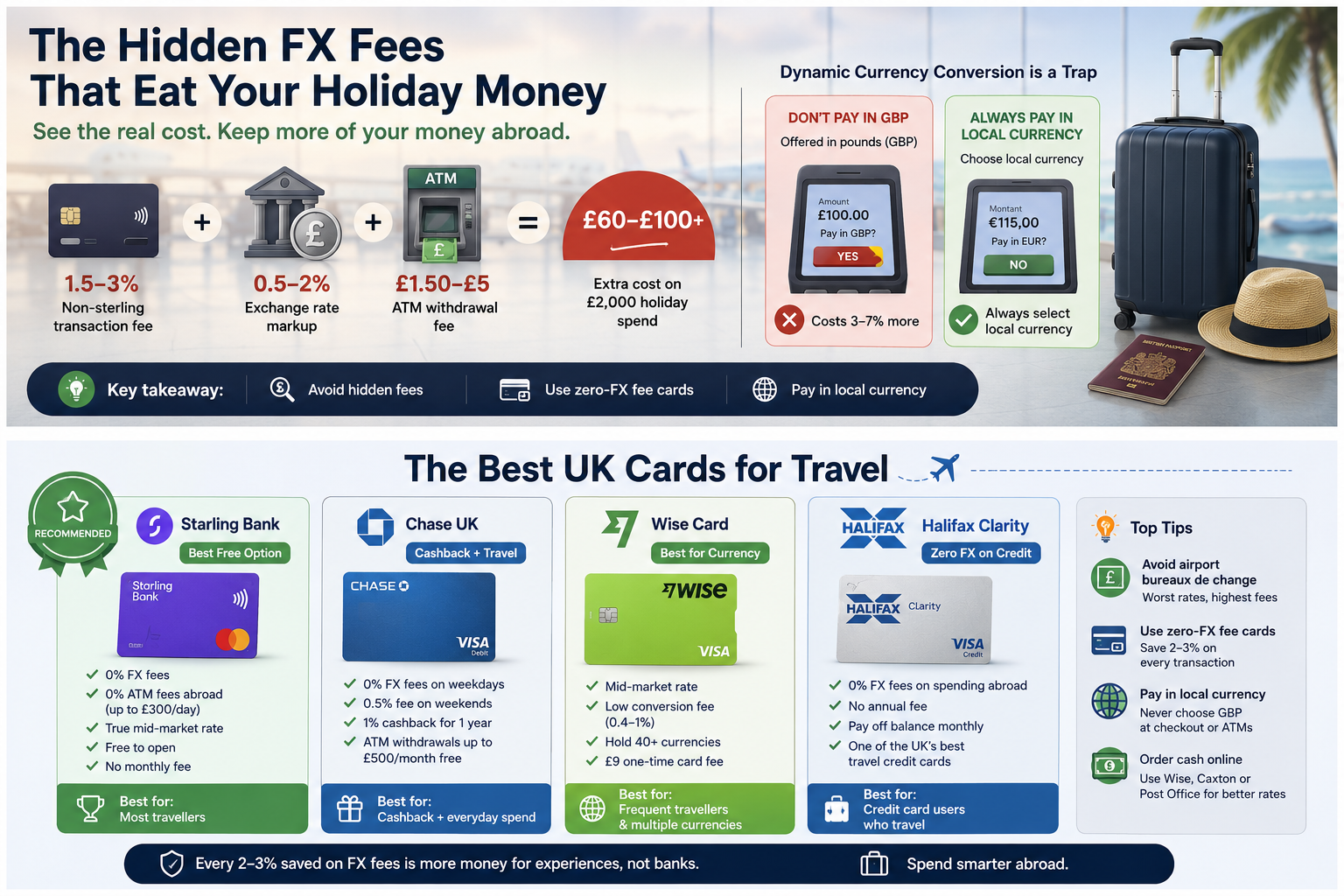
Where the money leaks
Card fee: your provider may add a non-sterling transaction charge to purchases abroad.
ATM fee: the cash machine operator and your own provider can apply separate charges or limits.
Conversion fee: Dynamic Currency Conversion lets the merchant or ATM set the exchange rate, which is often poor.
Check your card’s current terms before travelling and choose the local currency when paying or withdrawing cash. No single card is cheapest in every situation.
What You’re Actually Paying
When you use a standard UK debit or credit card abroad, there are up to three charges at play:
Non-sterling transaction fee (1.5–3%)
Applied on the converted amount by your bank. Barclays charges 2.99%. NatWest charges 2.75%. Lloyds charges 2.99%. This appears as a small extra charge on your statement, often days later.
Exchange rate markup (0.5–2%)
Banks don’t give you the actual interbank (mid-market) rate. They give you a worse rate and keep the difference. This is invisible — you never see it as a fee.
ATM withdrawal fee (£1.50–£5 flat)
Many banks charge a flat fee per foreign ATM withdrawal, on top of the FX fees. Some foreign ATMs also add their own charge.
The Actual Cost: Example Comparison
| Option | Rate on €1,000 | Your cost vs mid-market |
|---|---|---|
| Airport bureau de change | Often 8–12% worse | £80–£120 lost |
| High street bureau (M&S, Post Office) | 2–4% worse | £20–£40 lost |
| Standard UK bank debit card | ~3% total fees | ~£30 lost |
| Wise card | Mid-market + ~0.5% fee | ~£5 lost |
| Starling Bank debit card | Mid-market, 0% fee | ~£0 lost |
| Chase UK card | Mid-market, 0% fee (weekdays) | ~£0 lost |
The Best Cards for Travel
Starling Bank
Zero FX fees. Zero ATM fees abroad (up to £300/day). True mid-market rate. Free to open. No monthly fee. The simplest free option for most travellers.
Recommended
Chase UK
1% cashback on all spending for the first year. Zero FX fees on weekdays. Weekends carry a small fee (0.5%). ATM withdrawals up to £500/month free. Requires invitation or existing HSBC/First Direct customer.
Wise Card
Not a bank — a money transfer account. Holds and converts 40+ currencies. Small conversion fee (usually 0.4–1%). Best for frequent travellers or those needing multiple currencies. £9 one-time card fee.
Halifax Clarity Credit Card
Zero FX fees on spending abroad. No annual fee. You need to pay off the balance each month (it’s a credit card). One of the oldest “travel card” recommendations in the UK — still good.
The Dynamic Currency Conversion Trap
This happens at hotel check-outs, restaurants, and ATMs: the terminal detects your UK card and offers to charge you in pounds instead of local currency. It shows you the exact amount in GBP. It feels helpful. It isn’t.
When an ATM or card reader asks “would you like to pay in GBP?” or shows you a GBP amount — select no, or “pay in local currency.” Every time, without exception.
Currency: Order Online or Use the Card?
For most travellers, using a zero-fee card for all spending is simpler and cheaper than ordering cash. But cash has its place:
Order cash when
- ✓ Markets, taxis, rural areas often cash-only
- ✓ Countries with unreliable card infrastructure
- ✓ You want a small float for tips
Avoid cash when
- ✗ Buying at the airport bureau de change
- ✗ Using your bank’s in-branch ordering service at poor rates
- ✗ Taking large amounts you might not spend
If you do want cash, order online via Wise, Caxton, or the Post Office’s click-and-collect for delivery or branch pickup — the online rates are typically 2–4% better than walk-in rates.
Does Revolut count as a good travel card?
It can be, but with caveats. Free tier has weekend FX markups and monthly ATM limits. Paid tiers (Metal/Premium) are competitive but cost £6.99–£16.99/month. Starling is free and simpler for most people.
Are there countries where cards don’t work well?
Japan (especially outside cities), Turkey, Morocco, and parts of Southeast Asia still rely heavily on cash. Research your destination — even if cards are accepted, local ATMs may charge fees that dwarf the FX saving.
Is it safe to use a debit card abroad?
Generally yes. Visa and Mastercard have strong fraud protection globally. Keep a credit card as backup and check your bank’s daily foreign ATM limit before you go.